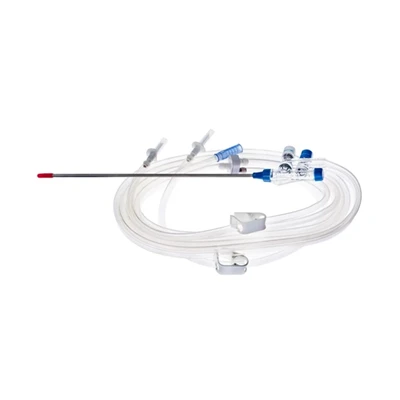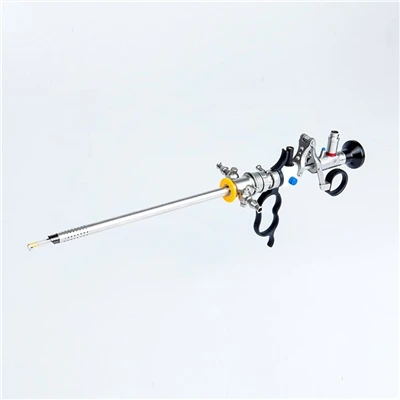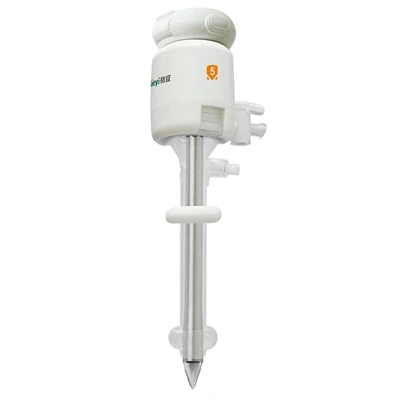
Trocar is a variant of trochar;from French troquard, an alteration of trois-quarts meaning three-quarters, from trois "three" and quart "quarter";first recorded in the Dictionnaire des Arts et des Sciences, 1694,by Thomas Corneille, younger brother of Pierre Corneille.
Originally, doctors used trocars to relieve pressure build-up of fluids (edema)or gasses (bloating). Patents for trocars appeared early in the 19th century, although their use dated back possibly thousands of years. By the middle of the 19th century, trocar-cannulas had become sophisticated, such as Reginald Southey's invention of the Southey tube.
Trocars are used in medicine to access and drain collections of fluid such as in a patient with hydrothorax or ascites.
In modern times, surgical trocars are used to perform laparoscopic (keyhole) surgery. They are deployed as a means of introduction for cameras and laparoscopic hand instruments, such as scissors, graspers, etc., to perform surgery hitherto carried out by making a large abdominal incision ('open' surgery), something that has revolutionized patient care. Today, surgical trocars are most commonly a single patient use instrument and have graduated from the 'three point' design that gave them their name, to either a flat bladed 'dilating-tip' product, or something that is entirely blade free. This latter design offers greater patient safety due to the technique used to insert them.
Trocar insertion can lead to a perforating puncture wound of an underlying organ resulting in a medical complication. Thus, for instance, a laparoscopic intraabdominal trocar insertion can lead to bowel injury leading to peritonitis or injury to large blood vessels with hemorrhage.